
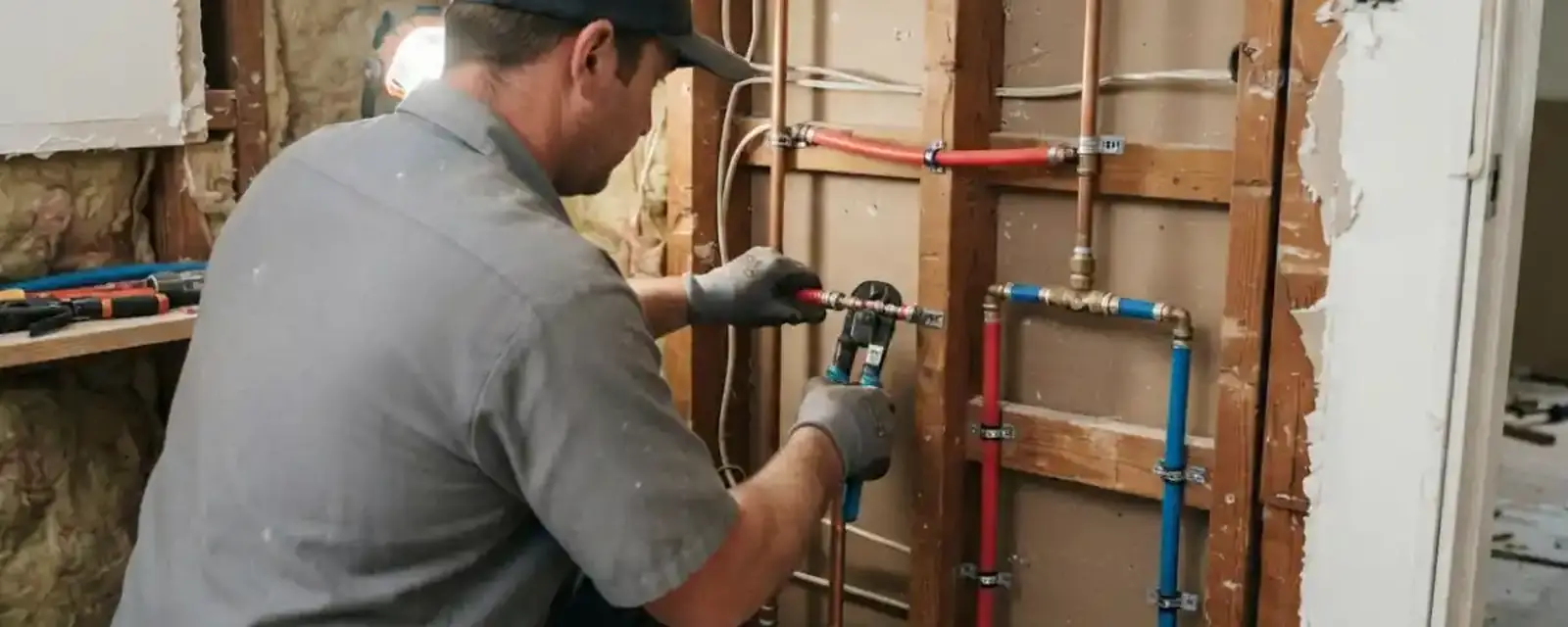
Short Answer: Yes, Copper and PEX Can Be Joined
PEX is a flexible plastic pipe used for hot and cold water lines. Copper is the metal pipe that older homes often use. Joining them is common, and plumbers do it every day with transition fittings made for the purpose.
The key idea is that you never glue or solder PEX itself. You attach a PEX-rated fitting to the PEX, and you attach the other side of that fitting to copper by solder, thread or compression. The fitting is the bridge.
Pipes do best when each end is cut square, the cut is clean and the fitting matches the pipe size. Most leaks at a transition come from a ragged cut, a half-seated fitting or a fitting that was never rated for the pairing.
Why Homeowners Convert Sections to PEX
PEX bends around corners, so a single run can replace several elbows and joints. Fewer joints mean fewer places for a leak to start, and the pipe goes through framing faster than rigid copper does.
Homeowners also convert when a copper section has pinhole leaks, when a remodel needs a new run, or when an old galvanized line has to be replaced. In each case, the new PEX ties back into the remaining copper at a transition.
PEX has limits. Manufacturers warn against long exposure to sunlight, and the pipe is not meant to sit against a hot flue or vent. Keep both rules in mind when you plan a route near a water heater.
Four Ways to Join PEX to Copper
Four fitting styles cover almost every home project. Each has a place, and a plumber picks one based on access and the pipe size.
| Fitting type | How it seals | Best use |
|---|---|---|
| Crimp ring. | Copper ring squeezed with a crimp tool. | Open walls with room for the tool. |
| Cinch clamp. | Stainless clamp tightened with a cinch tool. | Tighter spaces than crimp. |
| Expansion. | PEX expands over the fitting and shrinks back. | Permanent joints in walls and floors. |
| Push-fit. | Internal grab ring and seal. | Quick repairs and tight access. |
Push-fit fittings are the easiest to use and the most forgiving for beginners. They cost more per joint, and many plumbers prefer to leave them where they can be seen, because a buried fitting is harder to check later.
A Basic Transition in Six Steps
- Shut off the water. Close the main valve, open the lowest faucet and drain the line you plan to cut.
- Cut the copper cleanly. Use a tube cutter, not a hacksaw. Remove burrs inside and outside the cut.
- Prepare the PEX. Cut it square with a PEX cutter and slip the ring or clamp onto the pipe before the fitting goes in.
- Join the fitting to copper. Solder a sweat adapter, thread an adapter or seat a push-fit, depending on the fitting. Solder only on the copper side, and let it cool before you attach PEX.
- Join the fitting to PEX. Insert the barbed end fully, position the ring or clamp near the end and tighten with the matching tool.
- Test slowly. Open the main valve a little at a time and check every joint with a dry towel.
Never solder near PEX that is already attached. The heat can damage the plastic even when you cannot see it.
Transition fittings between copper and PEX should be listed for the use, as the 2024 International Plumbing Code (IPC) that underlies Georgia's state minimum plumbing code expects. Check the fitting packaging for the listing before you buy.
Old copper leaking at the joints?
Call the 24/7 line. A plumber can tell you whether a repair or a repipe fits your home.
Mistakes That Cause Slow Leaks Later
Most transition failures show up weeks after the work. Slow weeps behind drywall are the common result.
- Cutting pipe with a hacksaw and leaving a rough end.
- Skipping the depth mark so the pipe never seats fully.
- Mixing brands of rings and tools.
- Using a push-fit on a rough or scratched pipe surface.
- Closing the wall before a pressure test.
If you see a stain on a ceiling or a baseboard that stays damp, a hidden joint may be weeping. Our leak detection service can find that joint with listening gear and a thermal camera. Fixing a slow leak early costs far less than replacing the drywall and insulation around it.
Spot Repair or Whole-House Repipe?
A single transition is a fine fix when one section fails and the rest of the pipe is in good shape. A repipe makes more sense when leaks appear in several places, when the water turns brown, or when a plumber finds that the pipe walls are thin throughout.
Homes in the 1970s subdivisions around Peachtree Corners are now more than fifty years old. Original supply lines and fittings deserve an inspection, and a plumber can tell you whether a patch or a repiping project fits the house. If the break is between the meter and the foundation, a water line repair may be the right scope instead.
Ask for the options in writing. A good plumber will describe what each path covers and what each leaves for later.
What to Ask Before You Hire
Pipe work behind walls is hard to see once it is finished, so ask questions up front. A few questions separate a careful plumber from a rushed one.
- Can I see the plumber's Georgia license in the state lookup?
- Which fitting style will you use, and why that one?
- Will the work be pressure tested before the wall is closed?
- Does the job need a permit from the Peachtree Corners Building Division?
- What happens to the existing pipe, and who removes it?
Georgia's licensee search, called GOALS, is a free lookup run by the Secretary of State. Neighbors in Norcross and Dunwoody can use the same questions, and our dispatch line covers both towns.
Copper and PEX Questions From Peachtree Corners Homes
Yes, when you use a transition fitting rated for both materials and follow the maker's instructions. The weak points are rough cuts and shallow seating, not the pairing itself.
Plastic does not corrode against copper the way two different metals can, so PEX to copper transitions usually do not need a dielectric union. Check the fitting maker's instructions and ask your plumber about your specific parts.
Permit rules vary, and the Peachtree Corners Building Division enforces the Georgia State Plumbing Code. Call the division before starting any repipe so the work is inspected if required.
Manufacturers set minimum distances from hot flues and warn about heat, so follow the instructions that come with your pipe. Plumbers often use copper for the first stretch out of a heater and switch to PEX farther along.
Both can last for decades in a well-maintained home, and neither lifespan is certain. Water chemistry, pressure and installation quality matter more than the pipe alone.
Many manufacturers allow it, but plumbers often prefer to keep push-fit joints accessible. Ask whoever installs it, and test the joint under pressure before closing the wall.