
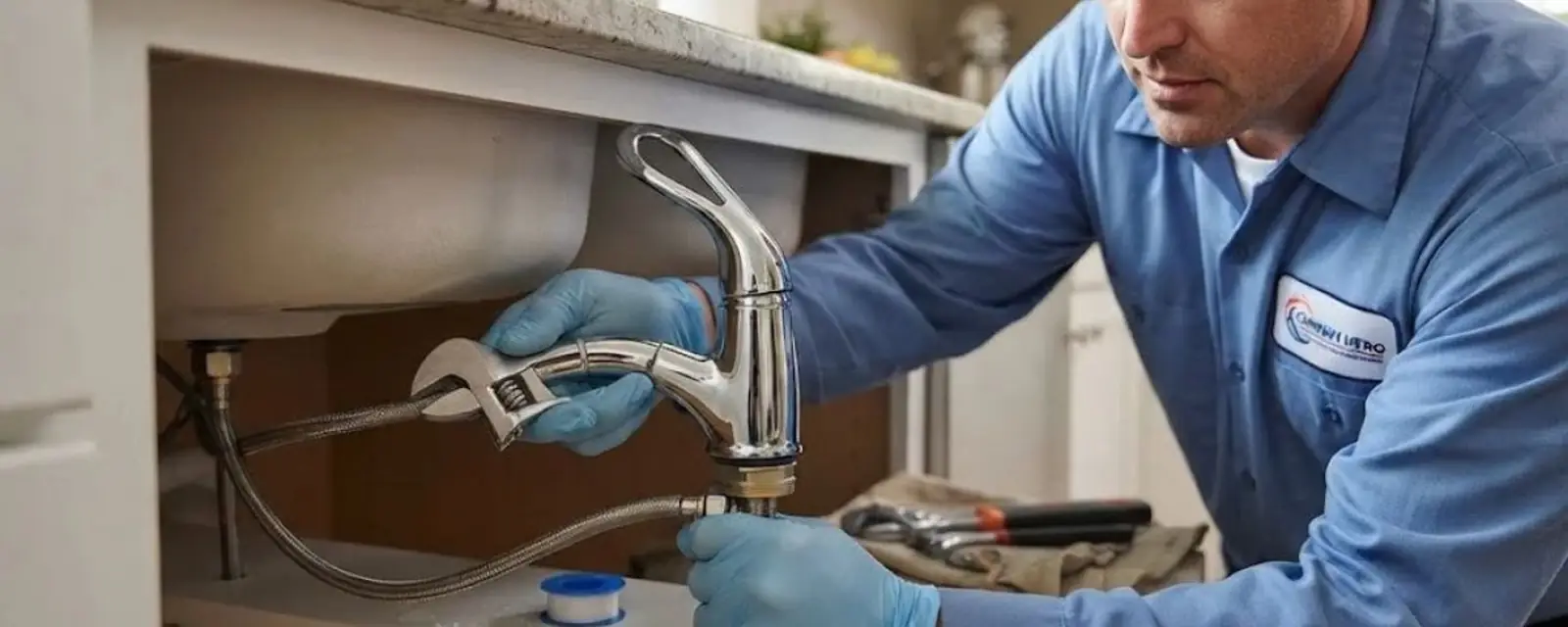
Why Faucets Leak
Every faucet has parts that seal against water pressure. Over time, those parts wear down. Rubber washers harden, O-rings crack, ceramic discs chip and brass seats corrode.
Water quality plays a role. Mineral deposits build up on moving parts and make them stick. Gwinnett County does not list a hardness figure in its annual report, so check your own water if scale shows up around the spout.
Leaks appear in different spots. A drip from the spout means the internal seal has failed. Water around the handle points to an O-ring or packing. A puddle under the sink may come from supply lines or connections rather than the faucet itself.
Identify Your Faucet Type First
The repair depends on the design. There are four common types, and each one uses a different internal part.
| Type | How it works | Common repair |
|---|---|---|
| Compression. | Two handles that you turn several times. | Replace the rubber washer and seat. |
| Cartridge. | A single handle or two handles with a cartridge insert. | Replace the cartridge or O-rings. |
| Ball. | A single handle over a rounded cap. | Replace seats, springs and the ball. |
| Ceramic disc. | A single lever with a wide cylinder body. | Replace the disc cartridge. |
If you are unsure, remove the handle and look inside. Take the old part to a hardware store so you can match it exactly.
Step-by-Step Repair
This repair suits most cartridge and compression faucets. Set aside about an hour and work in good light.
- Turn off the water. Close the shutoff valves under the sink, then open the faucet to release pressure.
- Plug the drain. A small part dropped into the sink is easy to lose.
- Remove the handle. Pry off the cap and unscrew the handle.
- Pull the cartridge or stem. Use a wrench and note the orientation.
- Replace worn parts. Swap in the matching washer, O-ring or cartridge.
- Reassemble and test. Turn the water on slowly and check for drips.
Keep every removed part in the order you took it out. It makes reassembly much easier.
Tools and Parts You Will Need
Most repairs need only a few tools. An adjustable wrench, a screwdriver, a hex key set and plumber's grease cover most situations. Plumbing tape helps seal threaded connections.
Buy parts by brand and model when possible. Generic kits work for some compression faucets, but cartridges are often specific to a manufacturer. A wrong part may fit loosely and leak again within days.
If you have to guess, take photos before disassembly and bring the old part to the store. Never force a part that does not fit smoothly. That usually damages the faucet body.
Replacement parts should match the faucet's model, and any new supply line should meet the fixture connection rules in the 2024 International Plumbing Code (IPC) behind Georgia's state minimum plumbing code. Universal parts often fit poorly.
Tried the fix and it still drips?
Call the line and a plumber will repair or replace the faucet.
When Replacement Beats Repair
Not every faucet is worth saving. If the body is pitted or corroded, new parts may not seal. If the valve seat is worn, even a perfect cartridge will leak. Older faucets also become harder to find parts for.
Consider replacement if you have repaired the same faucet more than once, if the finish is peeling or if you want better flow and features. A new faucet also gives you modern aerators that reduce water use.
Our faucet repair service covers both repair and replacement, and we can tell you which makes more sense after a quick look.
Signs the Leak Is Not the Faucet
Sometimes the drip comes from somewhere else. Water under the sink may be coming from the supply lines, the shutoff valves or the drain connection. A slow drip at the base of the faucet may be a loose mounting nut.
Dry the area with a towel, then watch for the first sign of moisture. Wrap a piece of tissue around each connection and see which one gets wet. If the problem is deeper than a simple part swap, stop and call a plumber.
If you also see a rising water bill, rule out a larger hidden problem with leak detection.
Special Cases: Outdoor Spigots, Tubs and Showers
Not every dripping fixture is a kitchen or bathroom sink. Outdoor hose spigots, tub spouts and shower valves each have their own quirks, and the repair differs from a simple sink faucet.
A hose spigot that drips from the handle usually needs a new packing nut or washer. If water leaks from the spout while the hose is attached, the vacuum breaker may have failed. A spigot that leaks inside the wall is more serious, because the pipe behind it may have cracked from a freeze. Shut off the supply to that spigot if you can and call a plumber.
Tub spouts that drip while the shower runs often have a worn diverter. Shower valves that drip from the showerhead after you turn them off usually have a worn cartridge. Those repairs may require opening the wall or accessing the valve from behind.
If you are not sure what you are looking at, take a photo and show it to a plumber. A few minutes of inspection saves time and keeps you from replacing the wrong part.
Simple Habits That Prevent Faucet Wear
Faucets last longer when they are treated gently. Turn handles off with moderate pressure rather than cranking them tight, because over-tightening wears washers and seats. Clean the aerator every few months to remove mineral buildup that restricts flow and strains the internal parts.
Look under the sink once a season. A quick check of the supply lines and shutoff valves catches slow drips early, before they damage the cabinet. Operate the shutoff valves once a year so they do not seize. If a valve is stiff or weeping, have it replaced while the sink is easy to reach.
What a Drip Costs You
The Environmental Protection Agency says a faucet that drips once per second wastes more than 3,000 gallons a year. That is water you pay for and do not use.
A small drip is easy to ignore, but it adds up on the bill and wears the valve seat further. The longer you wait, the more likely a simple cartridge swap becomes a larger repair.
If you decide to hire a plumber, ask for the repair or replacement option in writing before work begins. A clear quote protects both sides.
Faucet Repair Questions in Peachtree Corners
Yes. Use the shutoff valves under the sink. If they do not close fully or are stuck, shut off the main valve instead.
Heat can expand worn rubber parts and shift the seal. A new cartridge or washer usually resolves it.
If the faucet is old, corroded or has leaked repeatedly, replacement is often better. A plumber can inspect it and give you both options.
A dripping hose bib wastes water too and may be frozen or cracked in winter. Replace the washer or the spigot and call a plumber if the leak is inside the wall.
Yes. Our line is open every day. Dispatch gives you the earliest window and the plumber explains the repair before starting.