
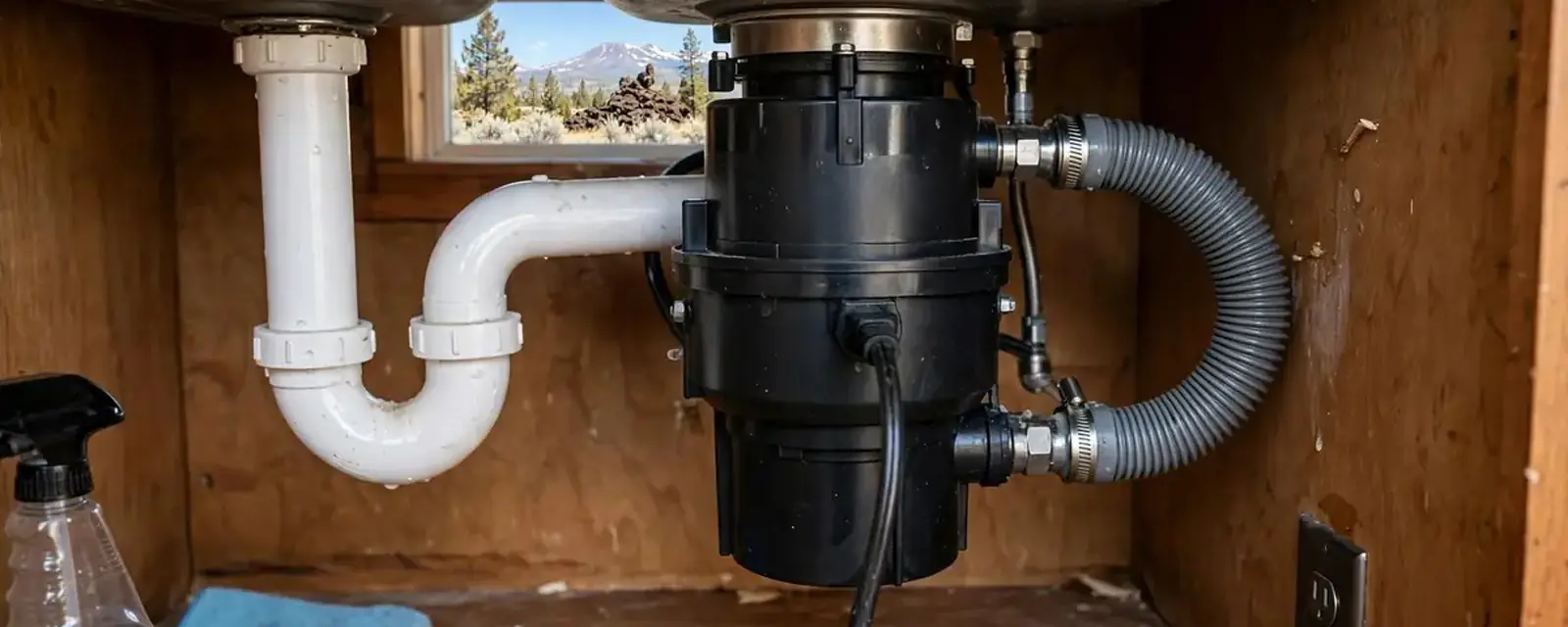
Quick Answer: Can You Install a Disposal Yourself?
Yes, in many homes. Swapping an old disposal for a new one of similar size is a common weekend project. It takes a few basic tools and about two hours when nothing is stuck.
Three situations make the job harder. There may be no outlet under the sink, the old unit may have been hard-wired by someone else, or the sink may have never had a disposal at all. In each case, new wiring or new drain parts are involved, and a plumber or electrician should handle those parts.
Read through the whole guide before you start. Knowing where the job gets complicated saves a trip to the hardware store with a half-disassembled sink behind you.
What Is in the Box and What You Still Need
A new disposal usually ships with a mounting assembly, a gasket and a power cord or wiring cover. You will still need a few items.
- Plumber's putty for the sink flange.
- A screwdriver and an adjustable wrench.
- A bucket and old towels for water in the trap.
- A new discharge tube or dishwasher hose clamp if the old ones look worn.
- A voltage tester to confirm the power is off.
Before you touch anything, switch off the breaker for the kitchen circuit. Test the outlet or the wires with the voltage tester. Do not rely on the wall switch alone, because a switch controls the unit and does not isolate the supply.
Installation in Eight Steps
- Cut the power. Turn off the breaker and confirm with the tester that the unit is dead.
- Disconnect the old unit. Place the bucket under the trap. Loosen the discharge tube, then support the old disposal while you twist its mounting ring free.
- Clean the sink opening. Remove old putty and debris from the drain hole so the new flange sits flat.
- Set the new flange. Roll plumber's putty into a rope, press it under the flange lip and push the flange into the sink opening.
- Attach the mounting assembly. Slide the gasket, backup ring and mounting ring onto the flange from below. Tighten the mounting screws evenly.
- Open the dishwasher knockout. If a dishwasher drains into the disposal, knock out the plug inside the inlet with a screwdriver and remove the plug piece.
- Hang the disposal. Lift the unit onto the mounting ring and turn it until it locks. Reconnect the discharge tube and the dishwasher hose.
- Make the electrical connection. Plug in the cord or wire the unit following the maker's instructions, then restore power only after all drain parts are tight.
Do not skip step six when a dishwasher is present. A plug left in the inlet causes dishwasher water to back up into the machine.
The Connections That Cause Most Leaks
New disposals leak in three places more than any others. Check each one before you close the cabinet.
| Where it leaks | Usual cause | Fix |
|---|---|---|
| Under the sink flange. | Too little putty or uneven screws. | Remove the unit and reset the flange with fresh putty. |
| At the discharge tube. | Loose or missing gasket. | Reseat the gasket and tighten the clamp. |
| At the dishwasher inlet. | Hose clamp not tight. | Tighten the clamp and check the hose end. |
Tighten the mounting screws a little at a time, moving around the ring, the way you would tighten a car wheel. Pulling one screw all the way down first pinches the gasket and leaves a gap on the opposite side.
The disposal's drain connection must meet Georgia's state minimum plumbing code, which follows the 2024 International Plumbing Code (IPC). That is one more reason to check the trap and dishwasher connection before you call the job finished.
Rather not wire it yourself?
Call the 24/7 line. A plumber can install the disposal and test the drain before leaving.
Wiring: Where Many Do-It-Yourself Jobs Should Stop
Some disposals plug into an outlet under the sink. Others are wired directly into a junction box. Plug-in units are simple to swap. Hard-wired units need correct wire connections and a grounded circuit.
If you do not have a switch or an outlet for the disposal, a new circuit element must be installed. Do not use an extension cord. Hand that work to a licensed electrician or to a plumber who coordinates the electrical piece.
Water damage from an electrical fault is rare, but a shock risk under a wet sink is real. If anything about the wiring looks scorched, brittle or mismatched, stop and call a professional. Our plumbing installation crews can handle the drain side and the fixture mounting for you.
Test It Before You Trust It
Restore the power and run cold water into the sink. Switch the unit on for a few seconds and listen. A smooth hum with no grinding or rattling means the mounting is solid.
Then check every joint with a dry paper towel. Hold it against the flange, the discharge tube and the dishwasher connection while water runs. Wet spots mean a connection needs another quarter turn or a reseated gasket.
Run the dishwasher through a short cycle if one is connected. Watch for water coming back into the sink or pooling in the cabinet. Check again the next morning for slow drips that took time to show up.
What to Grind and What to Skip
A disposal handles soft food scraps, small bits of cooked vegetables and leftover pasta in small amounts. Run cold water before, during and after to move waste through the pipe.
Keep the following out of the drain.
- Cooking grease and oil, which cool and coat the pipe.
- Coffee grounds in quantity, which form dense sludge.
- Fibrous scraps such as celery, corn husks and onion skins.
- Bones, fruit pits and shells.
- Rice and pasta in large quantities, which swell.
If a unit hums but does not spin, it may be jammed, and our garbage disposal repair service can clear and test it. Homes in Dunwoody and Johns Creek are served by the same dispatch line as Peachtree Corners.
Disposal Installation Questions From Peachtree Corners Homes
Permit rules vary by job, and the City of Peachtree Corners does not publish a simple rule for disposals. The Building Division at City Hall issues building, remodeling and trade permits, so ask them before you start, especially if you add wiring or change drain parts.
Only with the landlord's written approval. About 41 percent of Peachtree Corners housing is renter-occupied, so many homeowners and tenants face this question. A disposal alters plumbing and electrical connections that the landlord owns and insures.
You will need a sink flange that fits, a discharge tube that connects to the trap, and a power source near the sink. Those pieces often require a plumber and an electrician. A first-time installation takes longer than a swap.
Homes on the Gwinnett County sewer system send disposal waste into a public line, so use the unit lightly and keep grease out. A home on a private septic system should ask a septic professional before adding a disposal.
A jam usually produces a humming sound and no spinning. A burned-out motor is silent. Turn the power off before you check anything, and call a plumber if the unit stays dead after a reset.
A like-for-like swap often takes under two hours, though old corroded drain parts can add time. A plumber will tell you the likely scope after looking under the sink and will state the price before starting work.